
If you’re a serious freshwater lure angler then you’ve probably come across the Giant Snakehead. If you haven’t it’s time you did. This fish holds the BMF (baddest mother f#$&@*) title in the world of freshwater fish.
The Giant Snakehead is unlike anything else in freshwater. Not the biggest fish, not the rarest — but for aggression, power and the adrenaline of a topwater explosion— nothing comes close to this toothy torpedo.
This guide covers everything. What they are, where to find them, how to catch them, what gear you need and how to plan a trip.
What is a Giant Snakehead
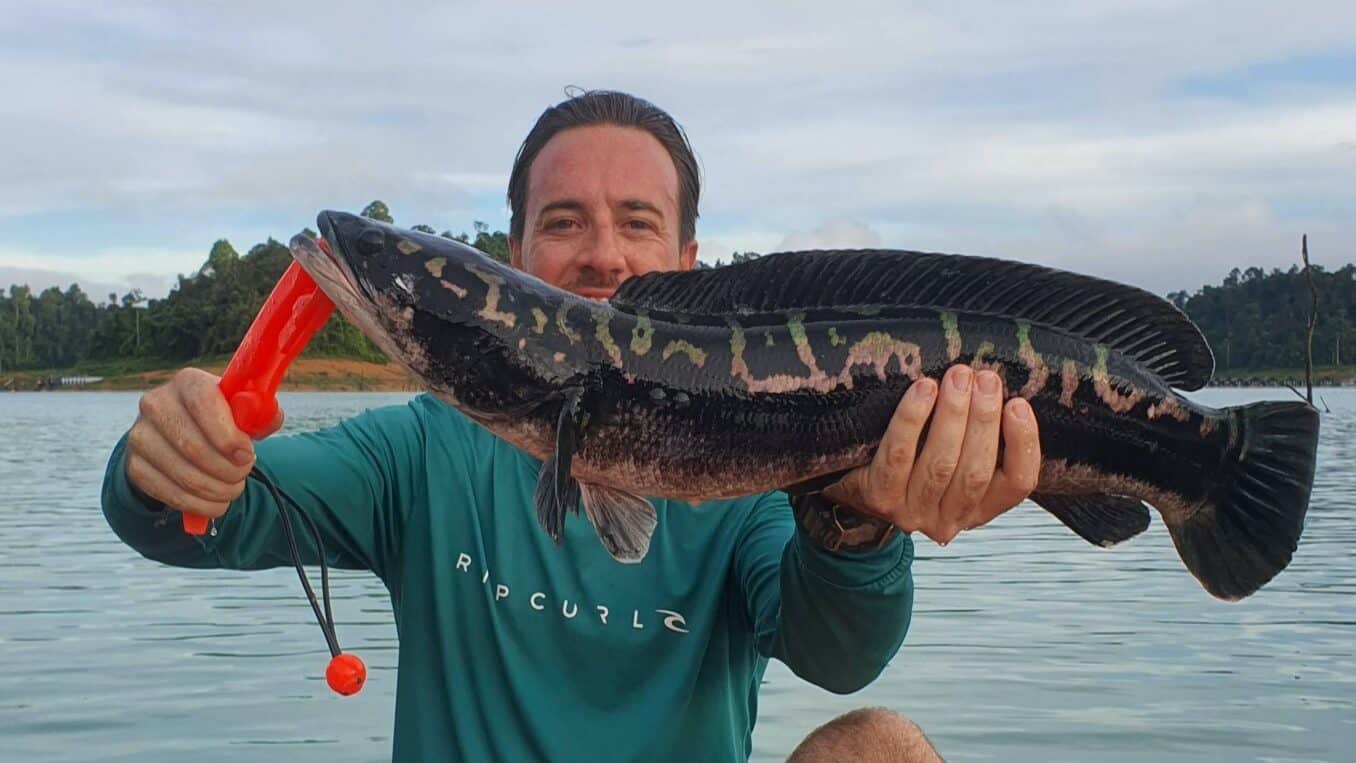
The Giant Snakehead (Channa micropeltes) is the largest of the snakehead family. Known as Pla Chado in Thailand, it has a long, muscular, torpedo-shaped body with a broad flat head and a mouth full of razor-sharp teeth.
It’s colouration varies through the year from completely black or black and dark grey with shades of blue-purple-white patterning and a white belly.
What makes them unique is their ability to breathe air. You’ll often hear them rise for a breath— and hear the telltale hiccup sound at the surface as it does so.
Quick Stats:
Max Length: 1.3m+ (4.3 ft)
Max Weight: 15kg+ (30 lbs)
Lifespan: 15+ years
World Record: 13.6kg (30 lbs), Rawang, Malaysia, 2018
The Species
Giant Snakehead grow fast — around 1kg in the first year, 2kg by year two, 5kg+ by year three. Spawning kicks off at the start of the rainy season, roughly April through October in Thailand. Both parents guard the eggs and fry aggressively. A parent Giant Snakehead will attack anything that comes to close — other fish, birds or your lure. This aggression is part of what makes them such an exciting target. You’ll often spot fish bitten in half that were unlucky enough to cross paths with an angry fish.
After hatching, the fry form a tight school. You’ll often spot these fry balls near the surface — a cluster of tiny red fish with one or two large and short tempered adults nearby.
Juveniles are bright yellow-red with orange and black stripes. As they mature they shift to the dark black-blue adult pattern.
Feeding-wise, they’re ambush predators. They sit in cover and wait for something to swim past, then smash it. Mostly other fish, frogs, crustaceans and even small birds. They’re most active around sunrise and sunset.
Where They Live
Giant Snakehead are native to tropical South East Asia — Thailand, Malaysia, Indonesia, Cambodia, Laos, Vietnam, Myanmar and Singapore and you’ll find them in most lakes, reservoirs, rivers and canals. Usually where there’s structure. Weed beds, overhanging vegetation, lily pads and fallen trees make ideal ambush locations, and that’s where your lure needs to be.
Thailand is the main destination for international anglers — great fishing infrastructure, easy to travel, and a mix of wild jungle and reservoir fishing or even city canals and stocked fishing lakes.
Why Fish For Them
The Strike
A Giant Snakehead hitting a topwater lure is one of the most violent things to see in freshwater fishing. The water explodes, it’s jaws clamp shut on your lure, your line goes tight and your rod bends! It’s adrenalin packed angling!
The Fight
They’re so damn tough and strong. Setting the hook requires multiple strikes and the instant they’re hooked they’ll dive hard towards the nearest structure. The first three seconds determine whether you land it or lose it. No light drag, no playing games. Strike, play it hard and keep it out of snags — or it’s gone.
We run guided Giant Snakehead trips across Thailand — single day sessions to multi-day jungle expeditions. View Our Trips →
Gear & Tackle
Everything needs to be strong, sharp and heavy duty to withstand their power and have any hope of landing a big fish!
Rods: 6’6″–7’6″ medium-heavy to heavy casting rod, rated 12–25 lbs. Solid backbone to set the hook through it’s bony jaw with enough tip to work topwater lures.
Reels: Low-profile baitcaster and fast gear ratio to get lures working quickly and winch fish hard. Spinning reel usually 3000-4000 series work best too.
Line: 30–60 lb braid. Zero stretch for hook sets, thin diameter for longer casts. Short heavy fluoro or even wire leader to protect against their teeth.
Hooks: Strong gauge, super sharp. Don’t cheap out here — thin hooks straighten, dull hooks won’t get into the fishes bony jaw.
Check our Gear guide for the best rods reels and tackle for Snakeheads!
Lures
Topwater is king.
Frogs — the go-to across South East Asia. Rubber and hollow-body frogs work best over heavy weed and lilies without getting snagged. Cast right into the thick of it where Giant Snakeheads love to hangout.
Buzzbaits & Prop Baits — great search baits for covering water fast and pestering fry balls in shallower water. Lots of surface disturbance to trigger a reaction bite.
Poppers and Walking baits — good for casting and staying in the strike zone, a loud surface pop can always trigger a bite. Good along weed edges and in more open water.
Diving Lures & Crankbaits — essential in the breeding season to target fry balls out in open water or dry season when fish move deeper and surface for a breath of air. Difficult to fish in heavily structured areas.
Swim baits and Spinners — versatile to punch into structure without getting snagged too easily and casted out into open water and fished at various depths.
On The Water
Start along the edges. Anywhere open water meets cover is a potential ambush point — weed lines, overhanging trees, submerged logs, bays off the main waterway. Watch the surface for fish coming up to breathe or fry balls bubbling and get a lure there fast.
Vary your retrieve. No single speed works every time. Slow and steady, fast and erratic, dead pause — experiment until something triggers a response.
From a boat: Keep moving but give every spot two or three casts. Fish don’t always bite on the first cast.
From the bank: Fan-cast and cover as much water as you can. Accuracy matters more than distance. Casting accuracy is everything with these fish especially if you’re sight fishing fry balls and surfacing fish. Random casting at structure is often quantity over quality. The more casts, the more fish but you still need to make sure you’re hitting spots that fish are likely to be in.
Best Time To Fish
You can target Giant Snakehead all year although some months are better than others.
Peak season — May to November. Breeding season usually falls into these months depending on the weather and location of the waters. Fish are guarding their nests or young fry and can be actively followed and persuaded to bite your lures.
Dry season — December to April. Higher temperatures make fish sluggish and water levels drop, bankside cover disappears and fish may move deeper. Harder work but still produces good fishing.
Time of day is the single most important factor regardless of season. Sunrise and sunset are prime times.
Planning Your Trip
Thailand is our favorite location to target this special fish. It’s vibrant culture, amazing people and an ideal climate make for an incredible fishing experience. Easy to travel around, great infrastructure, world-class food and hospitality, and a vast array of reservoirs, lakes and canals to target Giant Snakeheads.
Guided vs. self-guided: Unless you know the local guides and waters, a guided trip is best. A good guide knows which dams are fishing well and which lures and techniques are best to use.
What to expect: Early starts, long days, tropical heat, lots of casts. Most guided trips run from long-tail boats, sunrise to evening with an afternoon break during the hottest time of the day.
What to bring: Polarised sunglasses (essential), sun protection, UV blocking long pants and shirts. Most guides provide tackle but needs to be confirmed in advance.
We’ve spent years fishing for Giant Snakehead across Thailand. We know the water, we know the fish, and we’ll put you on them. All-inclusive guided trips — single days to multi-day expeditions. Plan Your Trip →
FAQ
How big do they get?
Over 1.3 metres and 20kg+. The world record is 13.6kg but bigger fish are out there. Anything over 5kg is solid, over 8kg is excellent, double figures is trophy territory.
Best lure?
Topwater frogs. Work through heavy cover without snagging and trigger explosive strikes. Buzzbaits, poppers and crankbaits all have their place depending on conditions.
Are they dangerous?
They’ll defend their nest aggressively and the teeth are razor sharp. But unprovoked attacks on people are myth. Use a lip gripper to hold them.
Can you eat them?
Yes. Widely eaten across South East Asia — commonly grilled in Thailand, valued in Chinese cuisine for firm white flesh. Most sport anglers practice catch and release.
Fishing licence needed in Thailand?
No general licence required. Some national parks and reservoirs charge entry or permit fees. Your guide handles it.
Best time of year?
Pretty much year round but your best opportunity are the months from May-November.
Can you fly fish for them?
Yes. 9 or 10 weight rod, strong leader, wire tippet. Surface flies that push water work best. Challenging but rewarding.