
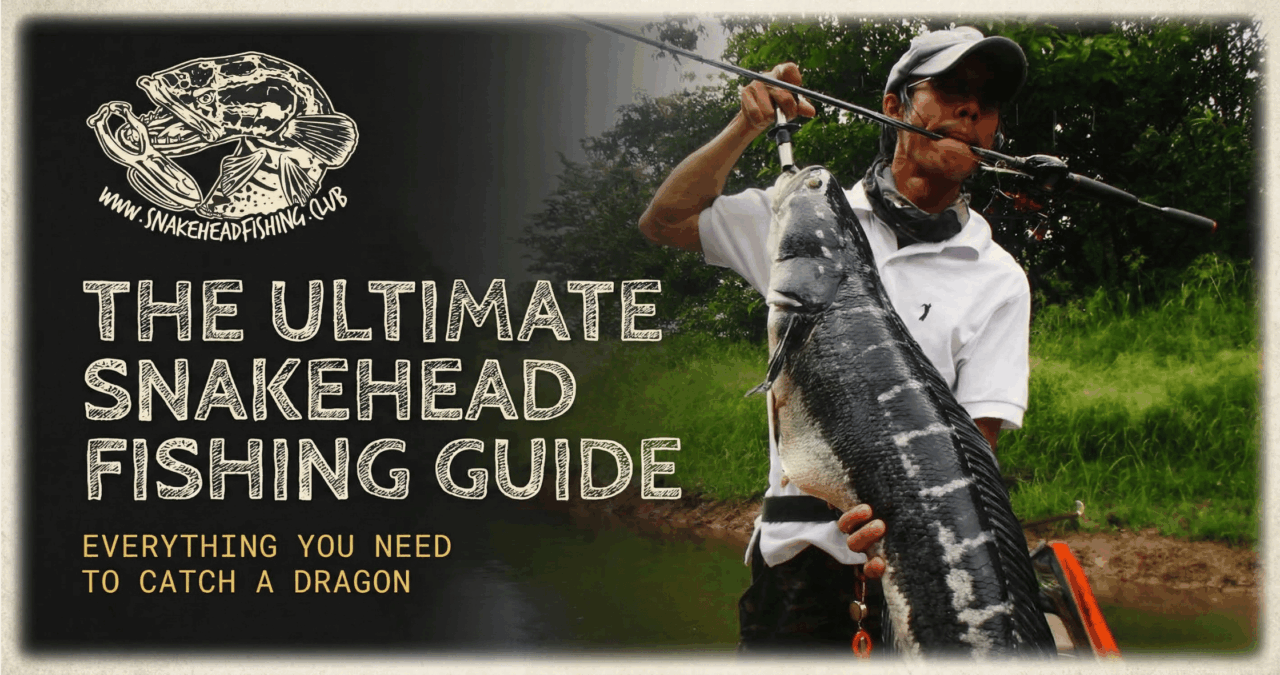
Few freshwater fish command the same respect as the Snakehead. Explosive strikes, brutal fights and a habitat that will test every piece of tackle you own — these fish are not for the faint hearted. But for those willing to pursue them, Snakehead fishing is one of the most rewarding experiences in freshwater angling.
This guide covers everything you need to know — from understanding the species and selecting the right tackle, to reading the water and putting fish on the end of your line. Whether you're picking up a rod for the first time or looking to sharpen the skills you already have, you'll find what you're looking for here.
We've spent years fishing for Snakehead across South East Asia and beyond. What you'll read is built on real experience, on the water, with these fish.
This post contains affiliate links — we may earn a small commission at no extra cost to you.
Species Guide
Snakeheads are a large family of freshwater fish native to Asia and Africa, with several species now established beyond their native range. For anglers, four species dominate — and two of them deserve your full attention.
Giant Snakehead / Toman (Channa micropeltes)
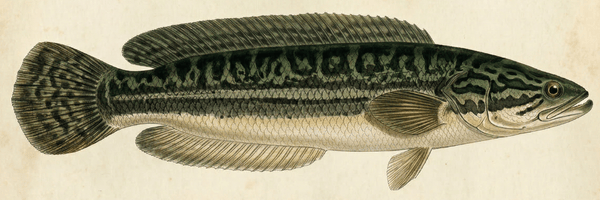
The Giant Snakehead is the apex predator of South East Asian freshwater fishing. Known locally in Thailand as Pla Chado and Malaysia as Toman, these fish are built for one thing — hunting. With a powerful torpedo-shaped body, a mouth full of sharp teeth and a bad attitude, the Giant Snakehead is the fish that defines the sport for most anglers in the region.
They are the largest of the Snakehead species, with fish exceeding 10kg caught regularly and reports of fish pushing beyond that. They are ambush predators that prefer heavily vegetated water — lily pads, reed beds, flooded jungle — anywhere they can sit unseen and explode on prey that strays too close.
What makes them exceptional as a target species is their response to topwater lures. Few freshwater fish attack a surface lure with the same aggression. The strike is violent, often aerial, and unforgettable.
Giant Snakehead are found throughout Thailand, Malaysia, Indonesia, Singapore and the Philippines and can be targeted year round.
Northern Snakehead (Channa argus)
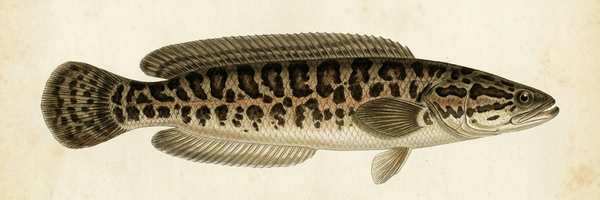
For anglers in the United States, the Northern Snakehead has become one of the most exciting freshwater targets available. Native to China and Russia, Northern Snakehead are now well established across the mid-Atlantic states — Maryland, Virginia and Delaware in particular — with populations continuing to spread through connected river systems.
They are smaller than their Giant cousins but no less aggressive. Northern Snakehead are ambush predators that respond well to the same topwater tactics that work in Asia, making them a natural target for lure anglers already familiar with bass fishing techniques.
Spring and Summer are peak season, with fish moving shallow and becoming highly aggressive during the spawning period.
Striped Snakehead / Haruan (Channa striata)
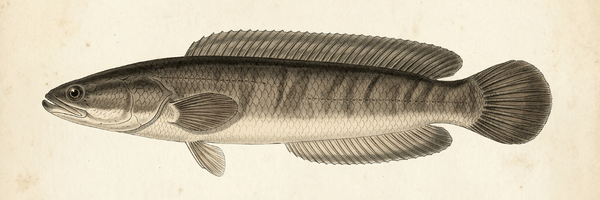
The Striped Snakehead — known as Haruan across much of South East Asia — is a smaller, more widely distributed species. Heavily farmed as a food fish, they are incredibly hardy and capable of surviving in water conditions that would kill most other species. Tactics for targeting them are largely the same as for Giant Snakehead, though scaled down in terms of tackle.
Bullseye Snakehead (Channa marulius)
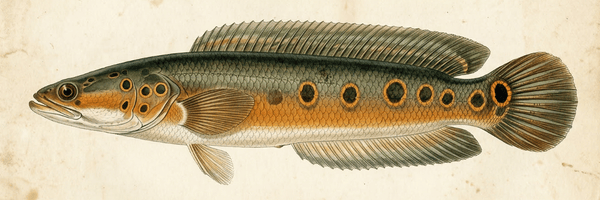
The Bullseye Snakehead is one of the larger species and arguably the most elusive. Found across South East Asia and now established in parts of Florida, they respond to the same lures and tactics covered throughout this guide.
Characteristics & Behaviour
Understanding how Snakehead behave is the single biggest advantage you can have as an angler. These are not random, opportunistic fish — they are calculated predators with predictable habits. Once you understand those habits, finding and catching them becomes significantly more consistent.
Feeding Behaviour
Snakehead are ambush predators. They do not chase prey across open water — they wait, hidden in cover, and strike when something comes within range. This explains their preference for heavily structured environments — lily pad fields, reed beds, submerged timber, overhanging vegetation — anywhere that provides concealment and a clear line of attack.
Their diet consists primarily of fish, frogs, crustaceans and small mammals. They are opportunistic and will eat almost anything that presents itself as an easy meal, which is why lures that mimic natural prey movement consistently outperform those that simply look realistic.
The Air Breathing Advantage
Snakehead possess a primitive lung-like organ called the suprabranchial chamber which allows them to extract oxygen directly from the air at the water's surface. This allows them to survive in poorly oxygenated water where most other predatory fish cannot.
Because Snakehead must regularly surface to breathe they are almost always holding in the upper water column. Topwater and shallow running lures consistently outperform deep presentations for exactly this reason.
During the dry season when water temperatures rise and oxygen levels drop, fish surface more frequently. Learning to recognise the subtle sound and disturbance of a surfacing Snakehead is a skill that will put you onto fish that other anglers walk straight past.
Territory & Aggression
Snakehead are highly territorial, particularly during breeding season when parent fish guard their fry with extraordinary aggression. A Snakehead protecting its nest will attack anything that enters its territory — not out of hunger but out of instinct. This is one of the most productive times to target them.
Outside of breeding season they remain aggressive but more selective. Presentation, accuracy and lure action become more important as the trigger switches from territorial aggression to genuine predatory instinct.
Myths Busted
Snakeheads have a reputation that far exceeds reality. Here's the truth behind the most common misconceptions.
Can Snakehead Walk on Land?
No. They can use their pectoral fins to move short distances across wet ground — but they are not crawling out of ponds and invading neighbourhoods. This myth has been heavily overdramatised by sensationalist media coverage.
Can Snakehead Breathe Air?
Partially true. They possess a suprabranchial chamber that allows them to extract oxygen from the air at the surface. This allows short-term survival out of water but they cannot live on land. It is however the reason they thrive in low-oxygen environments where other predatory fish cannot survive.
Will a Snakehead Attack a Human?
No. They are aggressive in defence of their young and will strike at anything that enters their territory during breeding season — but they do not prey on humans. Handle them with respect and the right tools and you will have no problems.
Seasons & Timing
Season Overview
| Species | Best Months |
|---|---|
| Giant Snakehead | Year round |
| Northern Snakehead | Spring & Summer (Autumn still productive) |
| Striped Snakehead | Year round |
| Bullseye Snakehead | Year round |
General Approach
Topwater lures are the most effective method for Snakehead across all seasons. Their weedless designs get into the heavy cover where Snakehead live, and the aerial strikes they produce are what makes this style of fishing so addictive.
Because Snakehead must regularly surface to breathe, they hold in the upper water column — which is exactly where topwater and shallow running lures do their best work. Presentations that get into thick structure without snagging will always outperform open water techniques.
Effective lures across all seasons include topwater frogs, jump frogs, buzz baits, spinner baits, swim baits, chatter baits and crank baits. Live and dead bait also works — Snakehead are opportunistic feeders and won't always turn down an easy meal.
Breeding Season — October to December (SEA) / Spring & Summer (Northern Snakehead)
This is the most productive time to be on the water. Snakehead guarding their nest will attack anything that enters their territory — not out of hunger, but pure aggression.
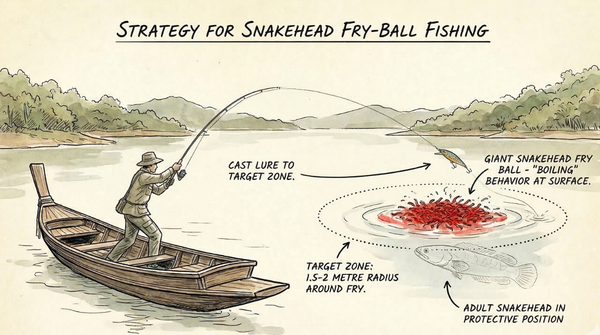
Giant Snakehead fry are bright red and surface regularly in a tight, writhing ball that resembles boiling water. Cast within 1.5-2 metres of the fry ball and work your lure repeatedly through the area. Parent fish are always close. Patience and persistence are key — repeated casts into the same zone will eventually trigger a strike.
A boat or kayak is a significant advantage during this period. Following a fry ball with repeated casts from the bank is difficult, and the best fish are often holding in areas that are impossible to reach on foot. If you lose sight of one fry ball, keep looking — where there is one there is often another nearby.
Depending on where the fish are you'll need to match your lure. Crank baits, swim-baits or spinners for open water or frogs, buzz-baits and spinners in thicker cover will all work to get an aggressive parent to bite if they think their fry are in danger.
Dry Season Sight Fishing (Giant Snakehead)
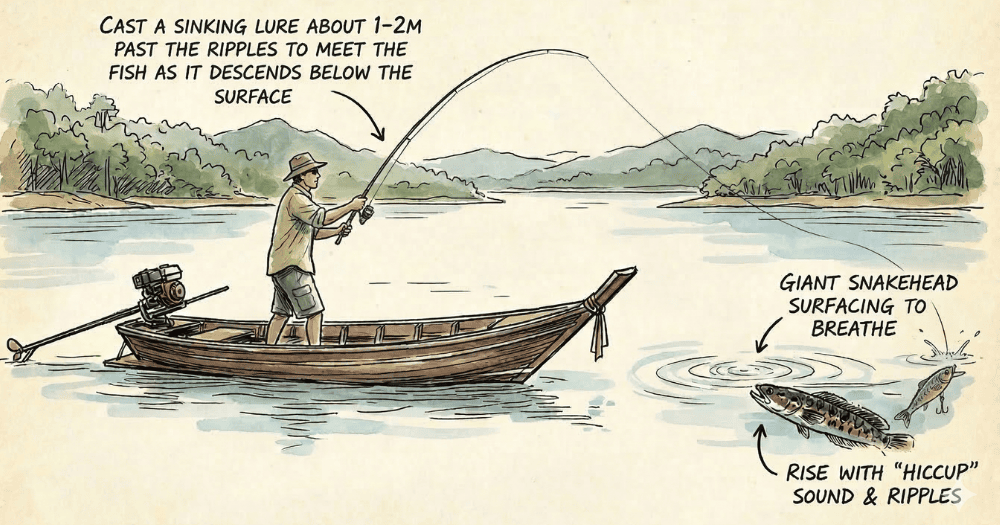
During the hottest months in SEA, rising water temperatures and falling oxygen levels push Giant Snakehead to the surface to breathe more frequently. Fish become visible but lethargic — aggressive presentations are less effective during this period.
The key is finding open water where fish are visibly surfacing. Listen for a distinctive hiccup-like sound — that is a Snakehead taking a breath. Cast past the rise, retrieve the lure across the fish's path and let it sink. Lures that can meet the fish on its way back down to depth consistently produce the best results.
Productive lures for this technique include crank baits, spinner baits, vibration spinners, chatter baits and swim baits.
Tackle Setup
Rods
A minimum of a medium-heavy rod is recommended for Snakehead. These fish head straight for cover the moment they're hooked — a rod with too much flex will cost you fish. You need the backbone to drive a hook into a bony mouth and the power to haul fish away from structure immediately after the strike.
Rod length matters too. Nothing shorter than 6'8" — the extra length aids casting distance, hook setting leverage and the torque needed to turn a fish in thick cover.
Our recommendation:
Baitcasting: Daiwa Tatula XT Series Casting Rods
Spinning: Okuma Snakehead Junky Spinning Rods
Reels
Any quality spinning or baitcasting reel from a reputable brand will do the job. For Snakehead we recommend a faster gear ratio for three reasons:
- Gets topwater lures working immediately on the retrieve
- Picks up line fast when a fish runs toward cover
- Easier to slow a fast retrieve down than speed a slow one up
Our recommendations:
- Spinning: Shimano Stradic FL Series Spinning Reel
- Baitcasting: Shimano Curado 200 M Baitcasting Reel
Line
A minimum of 30lb braid with a 40lb fluorocarbon or monofilament leader. Going lighter works but leaves you vulnerable on bigger fish. Snakehead are not line shy — don't talk yourself into going too light.
Terminal Tackle
Don't cut corners here. Snakehead will test every connection point in your setup.
- Use the strongest snap swivels you can find — if you can open it easily, it's not strong enough
- Replace factory treble hooks and split rings on crankbaits with quality aftermarket hardware
- Thin wire worm hooks will get straightened — use heavy gauge hooks throughout
Knots & Rigging
Keep your setup simple. Snakehead fishing doesn't require complicated rigging — a reliable connection from reel to lure is all you need.
Fishing with a Leader
The FG knot is our preferred method for connecting braid to a fluorocarbon or monofilament leader. It's a slim, strong connection that passes through rod guides cleanly and holds up under the aggressive headshakes Snakehead are known for.
- Leader breaking strength: minimum 40lb
- Leader length: around 50cm — short enough for comfortable casting, long enough to absorb abrasion from teeth and structure
- Connect the leader to your lure or snap with a Palomar knot — simple, strong and reliable
Fishing without a Leader
Some anglers prefer to go straight braid to lure. If that's your preference, the Bangkok Hooker Twist is the method we recommend. This knot effectively doubles or triples the braid at the connection point, significantly increasing its strength without the need for a leader. It also creates a loop at the end so no additional knot is needed to attach a lure or snap.
Snap Swivels
Using a snap swivel allows you to switch lures quickly without retying. For Snakehead fishing this is practical — you'll often need to change lures to find what's working. Use quality snaps only and check them regularly for wear. heavy gauge hooks throughout
Lure Guide
Lure choice for Snakehead is less complicated than many anglers make it. Movement and vibration consistently outperform colour and realism. A lure that gets into the right zone and behaves like something worth eating will catch fish — the brand on the packet matters far less than where you put it and how you work it.
That said, certain lure types are significantly more effective than others. Here's what works and why.
Topwater Lures
Topwater is the most exciting and most productive method for Snakehead. Their weedless designs get into the heaviest cover and the strikes they produce — explosive, aerial and violent — are what keeps anglers coming back.
Buzz Baits
If there is one lure that provokes a Snakehead into a strike out of pure aggression it is a buzz bait. Loud, disruptive and impossible to ignore — these lures are exceptional for covering large areas of water quickly and for targeting fish guarding their fry.
Snakehead will frequently launch full aerial attacks on buzz baits, clearing the water completely on the strike. It is as dramatic as fishing gets.
When selecting a buzz bait for Snakehead, louder is better. We recommend the inline variety — where the propeller sits directly in front of the hook — over the V-shape design. Inline buzz baits fish cleaner through vegetation and the hook position results in better hookups.
Our recommendation: Booyah Counter Strike Buzzbait
Frogs
Hollow Body Frogs
The hollow body frog has become the signature lure for Snakehead fishing. Weedless, versatile and available in a huge range of designs — cupped mouths for popping, built-in rattles, varied leg designs — there is a hollow body frog for every condition.
They can be worked slowly or quickly across the surface and their ability to float means they can be kept in the strike zone longer than most lures, increasing hookup chances over holding fish.
Snakehead specific versions of these lures have blades at the back of the frog in place of the rubber skirts that traditional hollow body frogs usually have. These blades (similar to those on spinners) flash and kick on the surface when retrieved, enticing Snakeheads to launch an attack.
Pro tip: Slightly bend the hooks upward and outward from the factory position — this dramatically improves hook-up rates on strikes.
Our recommendation: Googan Filthy Frog
Special Mention: Here's a complete KIT of frogs just for SNAKEHEAD
Soft Plastic Frogs
A hybrid between a hollow body frog and a buzz bait. The two paddle feet kick and splash on the retrieve producing a commotion that Snakehead find irresistible. They can also be fished subsurface — let them sink and the kicking action continues below the surface, making them one of the most versatile lures in the bag.
They are less durable than hollow body frogs and bodies can get damaged quickly — but the action they produce more than compensates.
Our recommendation: Strike King Super Toad
Jump Frogs
A lure developed specifically for Snakehead fishing in South East Asia. Typically wooden bodied with a rubber skirt and a weighted double hook, the Jump Frog bobs and pops gently on the surface on the retrieve — mimicking prey scurrying across the water's surface.
It is one of the easiest topwater lures to fish effectively and an excellent choice when exploring unfamiliar water. The hook always sits upright and most designs come fitted with a weedguard.
Our recommendation: Strike King KVD Sexy Frog
Specialty Lures
Skipping Lures
A technique growing rapidly in popularity across South East Asia. Skipping involves casting a lure so it bounces and skips across the surface — like a stone — under overhanging structure and deep into the cover where Snakehead hold. It puts a lure in places that conventional casting simply cannot reach.
Almost any larger soft bodied lure can be skipped but lures developed specifically for the technique feature fat body profiles and a single kicking leg — designed for maximum skip distance and strong topwater action once they settle.
Once in position the lure can be dead sticked, slowly retrieved or skipped back across the surface depending on what the fish want on the day.
Our recommendation: SNKHD Skippy
Subsurface Lures
When Snakehead are holding deeper or conditions make topwater less effective, subsurface lures are the answer. The key with all subsurface presentations for Snakehead is movement and vibration — lures that push water and trigger the lateral line consistently outperform finesse presentations.
Chatter Baits
Few lures match the erratic, high-vibration action of a chatter bait. The distinctive blade creates a frantic wobbling action that pushes significant water — exactly the kind of triggering movement that Snakehead respond to. Fish them with a rubber skirt and a paddle tail or fluke trailer for the best results.
Our recommendation: Madbite KastKing Chatter Bait
Spinner Baits
A proven, versatile option for Snakehead. Large profile, weedless design and fishable at multiple depths make spinner baits an excellent choice when fish are holding slightly deeper or in open water adjacent to structure. Opt for larger blade sizes — bigger spinners push more water and get more attention.
Our recommendation: Strike King Burner Spinner Bait
Crank Baits
Most effective when Snakehead are in open water — during breeding season when fish are actively guarding their fry, or during dry season sight fishing. They are less suited to heavy vegetation. Choose thicker plastic or wooden bodied lures — Snakehead teeth will destroy cheaper soft plastic cranks quickly. Match the crank depth with the water you're fishing to ensure the lure gets in the strike zone.
Our recommendation: Rapala Shad Rap 05
Swim Baits
The closest thing to live bait in lure form. Swim baits allow precise depth control through retrieve speed — slow down to fish deeper, speed up to keep them near the surface. Paddle tail varieties are particularly effective and fall into this category too.
Our recommendation: Googan Baits Saucy Swimmer
Soft Plastic Baits
The most versatile category in fishing. Flukes, paddle tails, creature baits, crawdads — all will catch Snakehead when rigged correctly. The variety of rigging options makes them adaptable to almost any condition. For Snakehead we keep it simple — a weightless or Texas rigged fluke is our go-to soft plastic presentation.
Our recommendation: Googan Baits Trench Hawg — Green Pumpkin
Bait Fishing
Snakehead will take live and dead bait — they are opportunistic feeders and won't always pass up an easy meal. While lure fishing produces the most exciting strikes, bait fishing can be highly effective, particularly in pressured water where fish have become wary of artificial presentations.
Live Bait
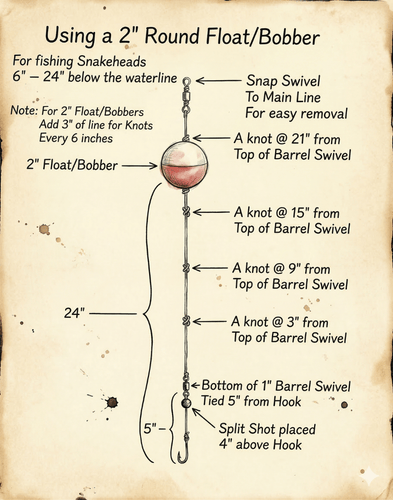
Live bait is the most effective option. Small fish, frogs and prawns all work well. Since Snakehead hold in the upper water column, a float or bobber is essential to keep the bait in the strike zone.
Dead Bait
Dead bait works best when it has a strong odour. Fish innards, chicken offal and strongly scented cut baits all produce results. Again, fish under a float to keep the presentation where the fish are holding.
Bait Fishing Rig
Keep the rig simple — a float set at the right depth, a strong hook and enough weight to hold the bait in position without restricting natural movement. Use the heaviest hook you can get away with — a Snakehead will straighten anything thin gauge without hesitation.
On The Water Techniques
Time of Day
Time of day is the single most important factor when planning a Snakehead session. Fish are most active during the early morning hours around sunrise and again in the evening around sunset. These low light periods are when Snakehead feed most aggressively and when topwater fishing is at its most productive. Fishing through the middle of the day in the heat is possible but expect significantly less activity.
Reading the Water
Snakehead are not randomly distributed across a body of water. They hold in specific areas — learn to identify these and you will find fish consistently.
Look for bays, inlets and passages of water that branch off main waterways. These quieter pockets of water are where Snakehead set up. Vegetated banks — lily pads, reeds, overhanging grass — are always worth targeting. The edge where open water meets vegetation is a particularly productive zone and should always be the first area you cover on a new piece of water.
Retrieve Techniques
There is no single correct retrieve for Snakehead — the fish will tell you what they want on the day. Start by varying your presentation until you find what's working:
- Slow retrieve — just enough movement for the lure to generate action. Effective on pressured or lethargic fish
- Fast retrieve — covers water quickly and triggers reaction strikes from aggressive fish
- Pause and twitch — let the lure sit, twitch it, let it sit again. Often the pause is what triggers a strike from a fish that has been following
Fishing from a Boat or Kayak
Keep moving and cover water efficiently. Don't linger too long in unproductive areas but always give a likely looking spot two or three casts before moving on — Snakehead don't always commit on the first presentation. A lure landing in a fish's zone more than once will often trigger a strike that the first cast didn't.
Fishing from the Bank
Fan casting is the most effective bank fishing approach. Work systematically through the water in front of you — cast to the left, work back to the right, covering every angle before moving along the bank. The goal is to cover as much water as possible without rushing past fish.
Switching Lures
If you're not getting bites don't persist with the same lure indefinitely. Switch it up — different action, different size, different depth. Sometimes a simple lure change is all it takes to turn a quiet session into a productive one.
Handling & Landing
The Strike
After a Snakehead takes a lure resist the urge to strike immediately. Drop the rod tip to create slack, give the fish a second to turn with the lure, then strike hard — more than once. Snakehead have hard bony mouths and a single soft strike will not drive the hook home. Set it hard and set it twice.
Keep the drag tight from the moment the fish is hooked. A Snakehead given any slack will be in the nearest weed bed before you can react.
Playing the Fish
Be aggressive. The moment a Snakehead is hooked your only objective is to keep its head up and get it away from cover. Use the backbone of the rod to apply maximum side pressure and gain line at every opportunity. A Snakehead that gets its head down into structure will find a way to throw the hook or break you off.
Landing the Fish
A net and a pair of boga grips are essential tools for landing Snakehead safely — for both you and the fish. Snakehead thrash violently when brought to the surface and will shake their heads aggressively to throw the hook right up until the moment they are secured.
Never put your fingers near a Snakehead's mouth. They have sharp teeth and a bad attitude — a set of long nose pliers for hook removal is not optional, it is necessary.
Recommended Gear:
Landing Net: KastKing Brutus Landing Net
Boga Grip: Original Boga Grip Fish Gripper
Pliers: KastKing AeroVice fishing Pliers
Catch & Release
We strongly advocate catch and release, particularly in waters native to Snakehead. Keep the fish in the water as much as possible, use wet hands when handling and return it quickly after photos. A fish handled correctly will swim away strong.
In the United States regulations vary by state regarding the handling of Snakehead as an invasive species. Check local regulations before you fish and handle accordingly.
 Don't try and remove hooks with your bare
hands unless hooks in your finger sounds like fun.
Eating Snakehead
Snakehead flesh is white, firm and surprisingly clean tasting for a freshwater fish. It lacks the muddy, earthy flavour associated with many freshwater species which makes it an excellent eating fish that holds up well to a variety of cooking methods.
In Asia, Snakehead has been a prized table fish for centuries. In China it is traditionally prepared for patients recovering from surgery — believed to have healing and restorative properties. In Thailand, Striped Snakehead is a staple of local cuisine and appears in markets and restaurants across the country.
Our Favourite Recipe — Kaeng Som Pla Chon
A classic Thai preparation that does full justice to the fish. A crispy fried Snakehead served in a hot and sour soup with water mimosa leaves and seasonal vegetables. Simple, fresh and exceptional.
Full recipe here: Kaeng Som Pla Chon
Western Preparation
For a more familiar preparation, Snakehead responds very well to simple pan frying or deep frying. The firm flesh holds together well and doesn't fall apart during cooking.
Full recipe here: Crispy Fried Snakehead
Final Thoughts
Snakehead are one of freshwater fishing's great targets — aggressive, powerful and found in some of the most exciting fishing environments on the planet. Whether you're chasing Giant Snakehead through the jungle lakes of South East Asia or targeting Northern Snakehead in the waterways of the US Eastern Seaboard, the fundamentals covered in this guide will put you in a strong position to catch them consistently.
Get on the water early, find the structure, vary your presentation and hold on.
Have questions or something to add? Drop a comment below — we read every one and update this guide regularly based on reader feedback and our own time on the water.
Ready to fish Thailand? Check out our guided fishing trips and let us plan your next adventure.